Descriptions Fairness and Freedom: A History of Two Open Societies: New Zealand and the United States Free OnlineFairness and Freedom compares the history of two open societies--New Zealand and the United States--with much in common. Both have democratic polities, mixed-enterprise economies, individuated societies, pluralist cultures, and a deep concern for human rights and the rule of law. But all of these elements take different forms, because constellations of value are far apart. The dream of living free is America's Polaris; fairness and natural justice are New Zealand's Southern Cross.
Fischer asks why these similar countries went different ways. Both were founded by English-speaking colonists, but at different times and with disparate purposes. They lived in the first and second British Empires, which operated in very different ways. Indians and Maori were important agents of change, but to different ends. On the American frontier and in New Zealand's Bush, material possibilities and moral choices were not the same. Fischer takes the same comparative approach to parallel processes of nation-building and immigration, women's rights and racial wrongs, reform causes and conservative responses, war-fighting and peace-making, and global engagement in our own time--with similar results.
On another level, this book expands Fischer's past work on liberty and freedom. It is the first book to be published on the history of fairness. And it also poses new questions in the old tradition of history and moral philosophy. Is it possible to be both fair and free? In a vast array of evidence, Fischer finds that the strengths of these great values are needed to correct their weaknesses. As many societies seek to become more open--never twice in the same way, an understanding of our differences is the only path to peace.
Take a Look Inside Fairness and Freedom 
How do we explain differences in relations between Europeans and native peoples in America and New Zealand? Part of the answer lies with the enlightenment-inspired leader Captain James Cook, who regarded all people as sharing a common humanity. | | 
How to create a society that offered equitable opportunities to people in search of land? The American solution: continuous acquisition of land to reconcile freedom and liberty with an idea of equity. An example is this broadside for new lands in Iowa and Nebraska (1872). | | 
Betty Friedan gave the new feminism a depth of purpose in her extraordinary book, The Feminine Mystique (1963), which centered on an old "problem that has no name" and a new goal of "raising consciousness" among women. To traditional ideas of liberty and freedom it added the idea of psychological liberation. | | 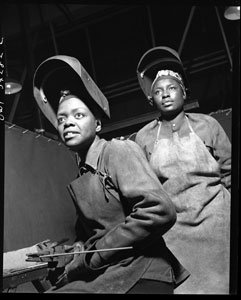
A pivot point in the history of racism was World War II. Under heavy pressure from Afro-American leaders, Franklin Roosevelt issued an executive order banning racial discrimination in war industries. The result was a revolution in economic opportunity, for those welders in New Britain, Connecticut, 1943, and millions of others. | |
compares the history of two open societies--New Zealand and the United States--with much in common. Both have democratic polities, mixed-enterprise economies, individuated societies, pluralist cultures, and a deep concern for human rights and the rule of law. But all of these elements take different forms, because constellations of value are far apart. The dream of living free is America's Polaris; fairness and natural justice are New Zealand's Southern Cross.
Fischer asks why these similar countries went different ways. Both were founded by English-speaking colonists, but at different times and with disparate purposes. They lived in the first and second British Empires, which operated in very different ways. Indians and Maori were important agents of change, but to different ends. On the American frontier and in New Zealand's Bush, material possibilities and moral choices were not the same. Fischer takes the same comparative approach to parallel processes of nation-building and immigration, women's rights and racial wrongs, reform causes and conservative responses, war-fighting and peace-making, and global engagement in our own time--with similar results.
On another level, this book expands Fischer's past work on liberty and freedom. It is the first book to be published on the history of fairness. And it also poses new questions in the old tradition of history and moral philosophy. Is it possible to be both fair and free? In a vast array of evidence, Fischer finds that the strengths of these great values are needed to correct their weaknesses. As many societies seek to become more open--never twice in the same way, an understanding of our differences is the only path to peace. .
complete books online for free. Reading
full free books online without downloading.
Looking up to the full article E-Books free download? Here you can read.

